
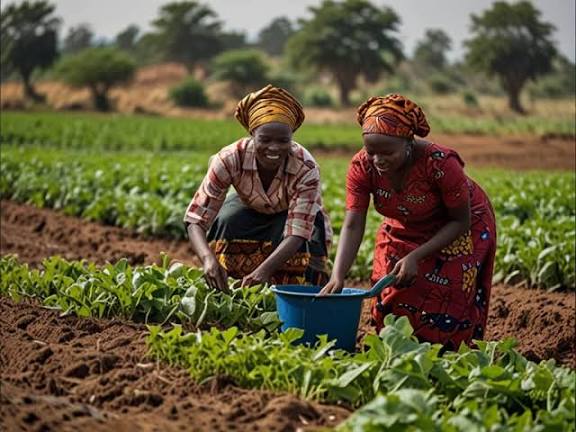
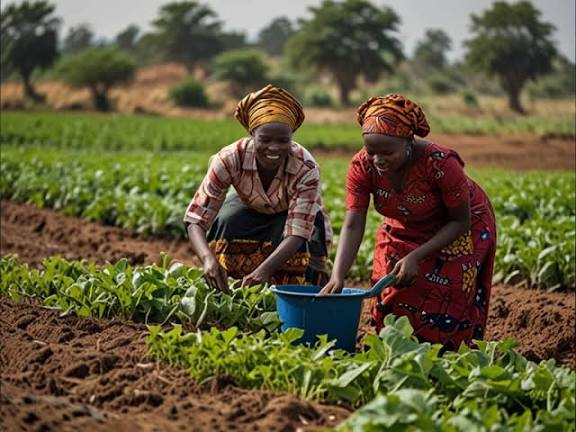
Each day in rural Benue begins with women stepping into the fields long before the world awakens. They cultivate the land that feeds the nation, yet the ground they nurture does not belong to them. Their work sustains families and fuels rural economies, but the absence of land rights reflects a larger inequality that continues to hold back Nigeria’s agricultural potential.
Across Nigeria, women form the backbone of agricultural labour. They do the bulk of planting and post-harvest processing, run small farms, and support entire value chains. But when it comes to owning the land they work, the numbers tell a stark story. A new report by BudgIT shows that female land ownership is almost nonexistent in most parts of the country. Only four states record more than 10 percent of women as landowners, while the majority fall shockingly low.
In some of Nigeria’s economically significant states, the gap is almost absolute. Lagos records a mere 0.5 percent female land ownership. In Ogun, it stands at 1.1 percent; Sokoto, 1.3 percent; Borno, 1.4 percent; and Kebbi, 1.5 percent. These figures reflect a longstanding pattern where women farm the land but rarely have the right to claim it. BudgIT described the situation as one in which women remain “tenants, not owners” in the nation’s agricultural economy.
Nowhere is this imbalance clearer than in Benue State Nigeria’s famed food basket. Here, nearly 88 percent of women working in the informal sector rely on farming for survival. Despite their dominance in agricultural labour, only 5.5 percent of these women possess legal land titles. The consequences are far-reaching.
Without titles, they cannot access commercial loans, because banks require collateral. They are routinely passed over for mechanisation programmes, government grants, and training schemes that demand proof of land tenure. What remains is a cycle of subsistence farming: low inputs, low yields, and little chance to scale up. Nigeria, already battling high food prices and inflation, cannot continue to overlook this critical segment of its workforce.
Ibrahim Kabiru, president of the Nigeria Agribusiness Group (NABG), explained that the land smallholders farm is often inherited or rented, making it nearly impossible to formalise. He advised women farmers to organise into cooperatives to access group credit or use what little holding they have to build bankable businesses. But even that solution depends on having, or being able to secure, land.
BudgIT estimates that closing the gender productivity gap could add over $2.3 billion to Nigeria’s economy gains that remain unrealised as long as women lack control over the land they cultivate.
While Nigeria’s laws technically protect women’s inheritance and property rights, the reality on the ground is far different. The Land Use Act places control of land in the hands of state governments, and several states have passed new laws modeled after the 2022 Female Persons Right of Inheritance of Property Law. But in many communities, customary and religious rules still dominate daily life.
Under such systems, land is traditionally passed down through male lineage, making widows and daughters dependent on fathers, brothers, uncles, or sons for access to farmland. Statutory rights may exist on paper, but customary practices continue to override them, leaving women locked out of ownership.
Economists warn that this land insecurity undermines nearly every effort aimed at improving agriculture. Access to improved seedlings, credit, equipment financing, or modern training cannot yield long-term results when women have no assurance that they will keep the land they invest in.
As BudgIT puts it, “Empowerment schemes without land reform are unlikely to shift productivity.” Limited ownership stalls asset-building and keeps rural women trapped in the same cycle that their mothers and grandmothers endured.
Today, women produce a large share of Nigeria’s food. Yet the absence of land rights keeps them excluded from wealth creation, agricultural investment, and decision-making reinforcing generational poverty.
Experts argue that if Nigeria truly wants to expand food production, stabilise prices, and transform rural economies, tackling gender inequality in land ownership is one of the fastest, most impactful steps the country can take.
As the report concludes, women’s lack of access to land is not merely a gender imbalance it is a national productivity crisis.