
By AgroBroadcast Team
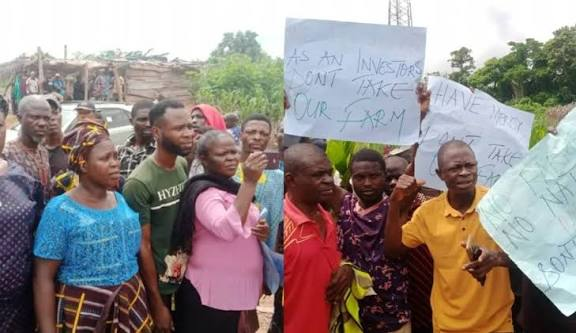
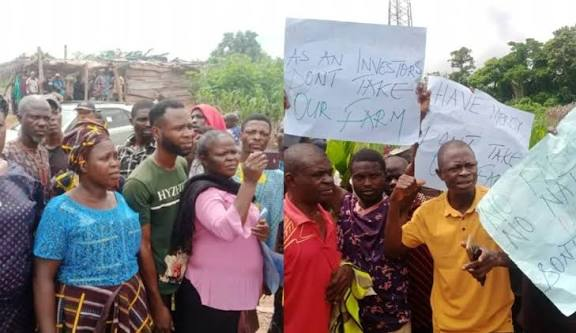
Tension escalated in Ondo State’s Oluwa Forest Reserve on Wednesday as hundreds of smallholder farmers from Odigbo Local Government Area marched to the Governor’s Office, protesting what they described as ongoing harassment, intimidation, and attempts to forcefully take over their farmlands.
The farmers many of them elderly cocoa growers who have cultivated the area for more than 20 years accused a man identified as Damilola Olowoniyi, allegedly acting on behalf of government-backed private investors, of blocking access to their allotted plots and threatening farmworkers.
Carrying placards and chanting solidarity songs, the protesters insisted they remain lawful tenants who have consistently paid government-approved annual dues. Their spokesperson, Adesoji Awotale, said the harassment intensified after the state government sold about 10,000 hectares in the OA3A section of the reserve to a private agribusiness firm, SAO Agro-Allied Services.
According to Awotale, the land sale displaced long-standing farmers and ignited months of conflict. Although the government later returned 2,000 hectares to affected communities with Irore Ajelanwa receiving 261 hectares farmers say agents continue to encroach on their remaining plots despite having verified documentation.
“We have paid millions in annual dues. We were preparing to pay this year’s dues before December 15. Yet we are being threatened and marginalised on the little land left for us,” Awotale said.“Many of our people, including men aged 60 to 80, have fled their farms out of fear. It is inhumane and economically devastating.
”Farmers say they have petitioned the Police Commissioner, the AIG Zone 17, the Inspector-General of Police and even the National Assembly but no decisive action has followed. A meeting scheduled with federal lawmakers was reportedly cancelled
Background: Years of Tension Over Forest-Reserve Allocations
The Oluwa Forest Reserve crisis forms part of a broader land-use conflict affecting multiple forest zones in Ondo State. Between 2024 and 2025, the state government allocated significant portions of forest-reserve land to private investors for commercial agriculture, particularly oil-palm plantations.
Key issues include:
Farmers say they were never consulted before land they had farmed for decades was sold.
A 2025 High Court injunction in Ore restrained the state government and private investors from evicting farmers or destroying their plantations pending final judgment.
Despite the injunction, farmers allege that private agents returned with bulldozers to clear land and issue threats deepening mistrust and triggering repeated protests.
Government Response
Addressing the protesters at the Governor’s Office, the Commissioner for Agriculture and Forestry, Olaleye Akinola, said the government had taken note of their grievances and invited Olowoniyi to a meeting scheduled for Thursday.
“We have convened a meeting where all parties and your representatives will be present. I can assure you that the government will take action,” Akinola said.
Efforts to reach Olowoniyi for comment were unsuccessful, as his mobile phone was switched off.
Why This Matters Beyond Ondo State
The dispute reflects a broader national dilemma: balancing large-scale agribusiness expansion with the rights of smallholder farmers who depend on forest-reserve lands for their survival.
In southwestern Nigeria a major hub for cocoa, plantain and food-crop cultivation land insecurity threatens food production, rural stability and long-standing farming traditions. Analysts warn that the outcome of the Oluwa crisis could shape policy responses to similar land-use conflicts cropping up in other states.
Farmers’ Demands
The protesting farmers are calling for:
Protection of their legal tenure and farm allocations
An end to harassment by alleged private agents
Enforcement of the High Court injunction restraining evictions
Transparent government action and, where necessary, fair compensation
Long-term land-use policies that safeguard smallholder farmers
As the crisis enters a new phase, all attention now shifts to the planned government–farmer–investor meeting, which the farmers hope will finally deliver justice and restore peace in the Oluwa Forest Reserve.