
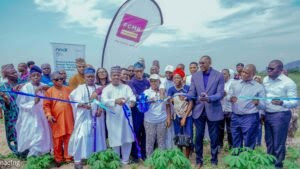
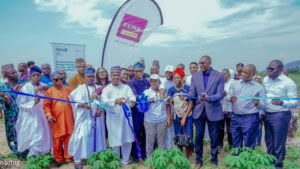
The National Agricultural Development Fund (NADF) has inaugurated a blended on-lending partnership with Psaltry International, targeting the empowerment of 12,000 young women in cassava cultivation across Oyo State’s rural communities.
Executive Secretary of NADF, Mohammed Ibrahim, disclosed this to newsmen in Abuja on Sunday, reaffirming the fund’s commitment to boosting agricultural growth, socio-economic development, and inclusive empowerment for women across Nigeria’s farming sector.
Represented by Abiodun Sosanya, General Manager, Corporate Services, Ibrahim said the first phase would directly engage 12,000 women, with the programme ultimately reaching 45,000 beneficiaries by the conclusion of the multi-year initiative.
Ibrahim stated NADF was contributing N798 million, representing 51 per cent of total funding, while the Mastercard Foundation provided 49 per cent through the NADF Blended Finance On-Lending Programme (NADFBFP) for structured agricultural financing.
“The financing will support the cultivation of 2,400 hectares of cassava, engaging women farmers through Psaltry’s structured network of outgrowers and ingrowers, ensuring productivity, efficiency, and inclusion in Nigeria’s agricultural value chain. FCMB will serve as the participating financial institution, facilitating smooth fund disbursement and complementing Mastercard Foundation’s financing of farmers’ input requirements to ensure timely access to quality inputs for cassava production.
”Ibrahim explained the programme guaranteed markets through backward integration, reduced production costs with subsidised lending, and promoted value addition for locally grown cassava, aligning with national priorities and boosting economic opportunities for women.
“The initiative also supports the food security and sovereignty goals under President Bola Tinubu’s Renewed Hope Agenda, demonstrating how structured agricultural finance can strengthen domestic food supply and reduce Nigeria’s dependence on imports.”
FCMB Chief Executive Officer, Yemisi Edun, described the partnership as transformative, emphasising that funding 2,400 hectares of cassava under the collaboration would scale production and bridge Nigeria’s agricultural finance gap significantly.
Edun, represented by Executive Director Obaro Odeghe, highlighted that the programme illustrated the power of public-private partnerships in repositioning agriculture as a key economic driver and promoting structured financing for smallholder farmers.
Founder and CEO of Psaltry International, Oluyemisi Iranloye, noted the inauguration coincided with Psaltry’s 20-year anniversary, marking a milestone in empowering women while enhancing local cassava production and agro-industrial capacity.
Iranloye said the programme would initially impact 15,000 women and expand to 45,000, producing food grains, starch, high-quality cassava flour, sorbitol, and glucose, supporting import substitution and strengthening domestic supply chains.“The initiative also targets youth, internally displaced persons, and persons with disabilities, demonstrating Psaltry and NADF’s commitment to inclusive growth, sustainable agriculture, and the creation of socioeconomic opportunities in rural communities.”Iranloye emphasised that the combination of public sector support, private banking guarantees, and backing from international foundations provided a scalable model for investment, productivity, and economic inclusion in Nigeria’s agricultural sector.
Projected Economic Returns — Analysis & Estimates
Key Data & Assumptions from Literature
1. Revenue and Profitability per Hectare
• A study in Ijebu-North (Ogun State) found that cassava production yields
-Total revenue: ₦368,000 per hectare
-Total cost: ₦257,515
– Net profit: ₦110,485
– ROI: ~₦1.43 gained for every ₦1 invested
• In another value-addition study (Ekiti State), the net return per hectare for processed cassava products:
– Gari: ₦18,328
– Lafun: ₦28,682
– Cooked Fufu: ₦17,446
– NROI range: 1.37–1.86
2. Value-Added Processing Margin
A 2025 study on cassava processing (starch, gari, confectionery) in Delta State reported:
– Avg revenue: ₦500,000
– Total cost: ₦237,000
– Gross margin: ₦263,000
– ROI: ~111%
3. Economic Scale & Market Potential
• Nigeria captures only 2% of the ~$180 billion global cassava derivatives market.
• Industrial cassava processing could unlock hundreds of millions of dollars via import substitution.
• FAO modelling suggests processed cassava could generate ~₦100 billion annually.
Projected Returns for the NADF–Psaltry Cassava Initiative (Estimate)
Key Metrics
Metric Estimated Value / Assumption
Area under production 2,400 ha
Revenue (per ha) ₦368,000
Total revenue ₦883.2 million
Net profit (per ha) ₦110,485
Total net profit ₦265.16 million
Value-Added Scenario (Processing)
If 50% of the harvest enters processing at ~111% ROI, potential value-added revenue could increase by hundreds of millions of naira, especially for products like HQCF, starch, sweeteners, sorbitol, and glucose.
Broader Economic Impact
• Import substitution: Reduces reliance on wheat flour, starch, sweeteners.
• Job creation: Strong employment potential across the value chain.
• Rural income: 12,000 women benefiting directly boosts community livelihood.
Risks & Sensitivities
• Processing inefficiencies and outdated equipment
• Access to credit for mechanization
• Low national average yields (~8 t/ha)
• Market absorption for industrial cassava products
Conclusion
• Estimated gross revenue: ₦883 million
• Estimated net profit: ₦265 million
• With value addition, ROI could more than double
• Strong potential for import substitution, job creation, and rural development.