
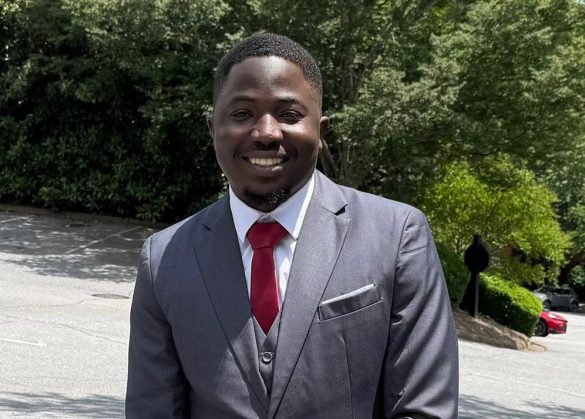
A Nigerian food systems expert based in the United States, Taiwo Kayode, has urged the Federal Government to introduce a national strategy that turns food waste into useful products, saying the move could save Nigeria billions of naira every year, boost public health, and strengthen food security.
Kayode described Nigeria’s growing food waste problem as both an environmental challenge and a lost economic opportunity, noting that large volumes of organic waste are discarded daily instead of being put to productive use. According to him, food waste remains an untapped resource the country has failed to properly harness.
He revealed that Nigeria loses between 30 and 40 per cent of the food it produces due to poor storage facilities, weak supply chains, and ineffective waste management practices.
“Food waste goes beyond sanitation.
It affects energy, the economy, and agriculture. Every time we burn or dump food waste, we are throwing away money and opportunities,” he said.
Kayode explained that many developed countries now use modern technologies such as anaerobic digestion, microbial chain elongation, and hydrothermal carbonisation to convert food waste into renewable energy, soil nutrients, and valuable industrial chemicals.
Currently completing his PhD in Sustainable Food Systems Engineering at the University of Georgia, he said these technologies, if properly adopted, could completely change how Nigerian cities handle organic waste.
His research focuses on combining these technologies to process high-volume waste materials such as food scraps, market waste, and agro-industrial effluents, turning them into clean energy and bio-based products like medium-chain fatty acids.
“Nigeria has enough waste, favourable climate conditions, and skilled scientists to lead Africa in waste-to-value solutions. What is missing is a clear national policy and the political commitment to expand these innovations,” Kayode stated.
Despite existing challenges, he noted that Nigeria already has key structures such as universities, research institutes, food processing companies, fertilizer producers, and local waste agencies that can be upgraded rather than replaced.
“We don’t need to create new institutions from scratch. We should strengthen existing ones. Universities can run pilot digesters, state waste agencies can receive basic treatment tools, private investors can be encouraged, and global technology partners can be engaged,” he said.
Kayode proposed a national roadmap that would shift Nigeria from landfill-dependent waste disposal to a circular bio-economy. This includes installing small and medium-scale digesters in markets and campuses, setting up regional biorefineries, and developing a coordinated policy that links agriculture, energy, climate action, and research.
He pointed out that cities such as Lagos, Abuja, Port Harcourt, and Kano generate thousands of tonnes of food waste every day enough to supply electricity to entire communities if effectively managed.
According to him, integrated waste-to-energy systems can also cut greenhouse gas emissions by up to 50–70 per cent, depending on the type of waste and technology used.
Kayode has published widely in international journals, spoken at global conferences, and worked with research teams advancing circular bio-economy solutions that can be adapted for Nigeria.
However, he identified poor infrastructure, lack of reliable waste data, weak enforcement of waste separation, and limited cooperation between policymakers and researchers as major barriers slowing progress.
He called on Nigerian leaders to treat food waste reduction as a national priority linked to job creation for young people, agricultural sustainability, urban cleanliness, and public health.
“No country can build a strong modern economy while losing one-third of its food and spending billions to manage waste that could be generating power,” he said.
Kayode reaffirmed his commitment to partnering with Nigerian institutions, state governments, and communities to turn food waste into economic value.
“Food waste should not be a national problem. It can become Nigeria’s pathway to cleaner energy, new industries, and a circular economy. With the right plan, waste can become wealth, and pollution can be transformed into power,” he concluded.