
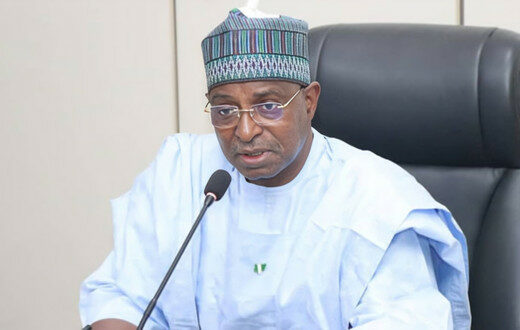
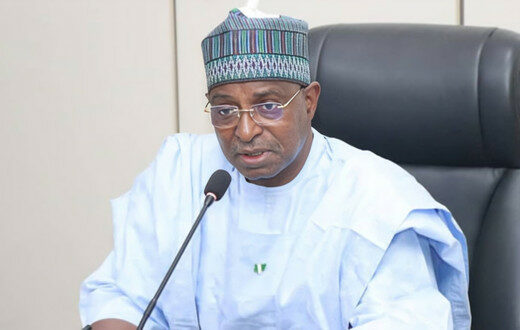
The Federal Government has reaffirmed its commitment to ranching as the backbone of Nigeria’s sustainable livestock development, emphasizing its viability as a long-term solution for boosting productivity and addressing challenges in the sector. This position was restated by the Honourable Minister of Livestock Development, Idi Mukhtar Maiha, during an inspection visit to Manchong Integrated Farms Limited in Nasarawa State.
The Minister, who led a team of top ministry officials and industry stakeholders to the facility on Thursday, December 19, 2025, described the farm as a practical example of how modern ranching can thrive under Nigeria’s environmental conditions. He noted that the operation clearly demonstrates that ranching is not only achievable but can be expanded and sustained across the country.
Maiha explained that the farm operates an integrated livestock system that combines efficient animal management, year-round fodder production, effective water use and genetic resource development. He observed that despite the dry season, the farm maintains healthy green pastures through natural irrigation, dispelling long-held beliefs that ranching is limited by climate in Nigeria.
According to the Minister, the success of the operation serves as a strong proof of concept for nationwide adoption.
“Ranching simply involves managing livestock within a defined space with adequate feed, water and proper care,” Maiha said. “What we have seen here proves that this system works in Nigeria and can be replicated on a larger scale.”
He disclosed that Manchong Integrated Farms currently cultivates improved grass varieties such as Mombasa, Napier and Brachiaria, manages over 300 cattle across key beef and dairy breeds, and produces surplus animal feed annually. Based on these achievements, the Federal Ministry of Livestock Development plans to collaborate with the farm on feed and fodder seed multiplication, as well as genetic improvement initiatives.
Maiha added that the farm’s ongoing supply of fodder to states including Jigawa and Yobe provides a solid foundation for scaling a national feed system.
“Our objective is to build a nationwide feed framework that allows small-scale livestock producers to access quality fodder wherever they are. This will enhance productivity, reduce losses and stabilise the livestock value chain,” he stated.
On genetic development, the Minister announced that the farm would serve as a pilot centre for upcoming breeding programmes under the ministry’s reform agenda.
“For the genetic materials we intend to introduce into the country, this farm will be among the first to produce offsprings that can be multiplied and distributed nationwide. It will serve as a reference point for what is possible,” he said.
Earlier, the owner of Manchong Integrated Farms, Hon. Yakubu Dogara, praised the Minister for adopting a hands-on, field-driven approach to policy implementation. He explained that the farm was established to demonstrate ranching as a practical solution to long-standing farmer–herder conflicts, particularly in northern Nigeria.
“We set out to prove that ranching is not a theory but a workable and profitable model. Replicating this system can reduce insecurity, encourage peaceful coexistence and unlock major economic opportunities,” Dogara said.
He further highlighted the economic prospects of the livestock industry, noting that the global beef and dairy market is valued at approximately 2.5 trillion dollars, while northern Nigeria accounts for over 70 per cent of the country’s livestock population.
“If Nigeria captures just five to ten per cent of that market, it could earn about 25 billion dollars annually. The potential is enormous, but it requires intentional investment and consistent policies,” he added.
Also speaking during the visit, a livestock business partner to the Botswana Embassy in Abuja, Mr. Clinton Agbo, described the farm as a strong platform for international cooperation.
“This is my second visit here, including one with the Botswana High Commissioner. We see this facility as an ideal site for launching a pilot programme. The vision is Pan-African with Botswana providing support and Nigerians leading implementation for the benefit of the continent,” he said.
Industry observers note that the inspection reflects a growing shift in Nigeria’s livestock policy toward practical, investment-driven approaches, with ranching increasingly positioned as a key tool for food security, economic diversification and sustainable peace.