
By Agrobroadcast Team
For many farmers across rural communities in Niger State, the harvest period has failed to deliver the relief and celebration it once promised. Instead of rewards for months of labour, farmers are confronting a harsh economic reality marked by sharply declining produce prices, soaring input costs and policies they believe prioritise consumers over producers.
Across farming settlements, there is a growing feeling of neglect. Farmers say national economic decisions rarely reflect the daily struggles in rural areas, where poor roads, weak market linkages, inadequate storage facilities and limited access to affordable credit continue to undermine productivity and income.
Agricultural experts caution that if the trend continues, the consequences could be severe. Persistent losses may force farmers to scale back production or abandon farming entirely, worsening Nigeria’s long-term food security situation.
Many farmers disclosed that they are already trapped in debt. Loans obtained at the start of the planting season have become difficult to repay, with some creditors reportedly resorting to extreme recovery measures, including arrests. The situation is made worse by the imbalance between collapsing farmgate prices and the rising cost of essential goods and services.
According to the farmers, post-harvest earnings were traditionally used to fund major life goals such as embarking on the hajj pilgrimage, building or repairing homes, or purchasing motorcycles to ease farm transportation. This year, those dreams have largely evaporated as produce prices continue to slide.
While consumers enjoy some relief from lower food prices, producers say they are bearing the brunt of the adjustment. High fuel costs have further inflated transportation expenses, cutting deeply into already thin margins.
The impact is evident in personal stories from farming communities. In Gbako Local Government Area, Mallam Hussaini Abdullahi recalled that 17 farmers from his village were able to pay for hajj slots in 2025 after selling their produce. This year, despite a better harvest, none has been able to do so. The Niger State Pilgrims Welfare Board has also confirmed a noticeable drop in deposits from farmers for the 2026 pilgrimage.
In Bosso Local Government Area, farmer Mohammed Sani Idris Kodo warned that the situation is pushing young people out of agriculture. “Farming is a business, and right now it is running at a loss. When paddy rice sells for between ₦30,000 and ₦40,000 per bag, how do you repay loans?” he asked, noting that many may abandon farming next season.
Women farmers are equally affected. Zara’u Usman lamented the widening gap between food prices and household needs. “A mudu of millet sells for ₦350, but palm oil is ₦2,000 per bottle. How do we afford clothing and other necessities?” she asked. Another farmer, Jamila Ibrahim, said her plans to renovate her room and buy a new bed collapsed after learning that a mattress now costs about ₦250,000, while a bag of maize sells for just ₦20,000.
In Beji community, Abbas Audu revealed that five of his siblings had postponed their weddings due to rising building material costs. “Zinc, cement and nails are now too expensive. Some families have resorted to using thatch instead of zinc roofing,” he said.
Farmers largely blame government intervention in the food market for their worsening fortunes, particularly the importation of food items aimed at curbing inflation.
They argue that the influx of imported produce has depressed local prices and weakened domestic agriculture.
The effects are already visible in dry-season farming. Investigations show that many farmers have either abandoned irrigation farming this year or drastically reduced their scale of operation.
In Wushishi Local Government Area, Alhaji Mahmud Bala Egge, secretary of the All Farmers Association of Nigeria (AFAN), said he cultivated 15 hectares of rice last dry season but can barely manage one hectare this year due to low prices and expensive inputs.
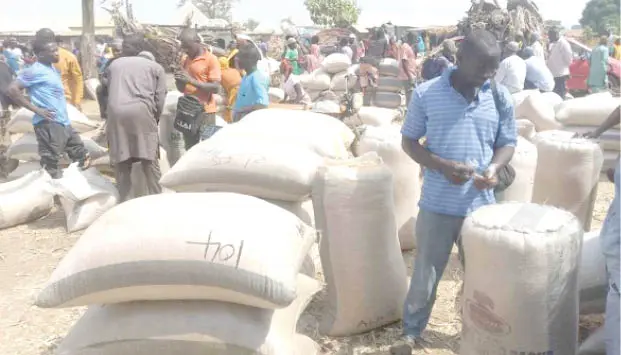
At Gunu Market, the chairman of the Grain Sellers Association, Murtala Yusuf, described the situation as unfair and unsustainable. “I borrowed ₦100,000 when a bag of white beans sold for ₦100,000. Today, that same bag is worth ₦35,000. How does one survive that?” he asked.
Agriculture stakeholders are now urging authorities to rethink their approach. Prof. Olalekan Busra Sakariyau, an agribusiness expert and Africa representative of Family and Care Farm, Germany, stressed the need to strengthen local production rather than rely on imports.
“Food importation is not a long-term solution,” he said. “Value addition through processing, improved storage and smart farming practices is critical. Nigeria loses up to 40 per cent of its food annually, especially fruits in states like Kano and Benue, due to poor storage and processing infrastructure.”
As farmers count their losses, many warn that without urgent policy adjustments to protect producers, today’s cheaper food prices may come at the cost of tomorrow’s food shortages.