
By Agrobroadcast Team
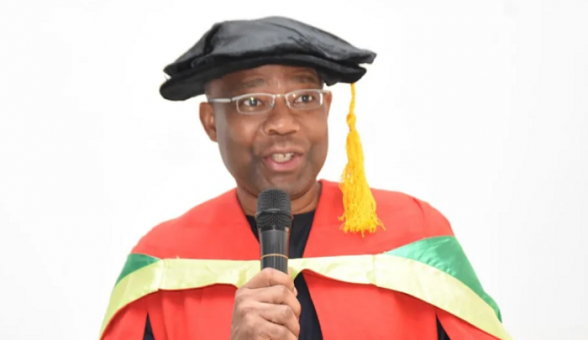
Nigeria must deliberately reposition agriculture as the backbone of its employment strategy if it hopes to achieve inclusive growth and long-term economic stability, Chairman of Access Holdings Plc, Mr. Aigboje Aig-Imoukhuede, has said.
Delivering the 33rd Convocation Lecture of the Federal University of Agriculture, Abeokuta (FUNAAB) at the weekend, Aig-Imoukhuede argued that sustainable national development would remain elusive unless agriculture is redesigned as a coordinated, system-driven sector capable of absorbing millions into productive work.
Speaking on the theme “Agriculture, the Future of Work, and the University as Catalyst,” he urged policymakers, academic institutions and young graduates to abandon outdated perceptions of farming and embrace agriculture as Nigeria’s most scalable platform for dignified employment, innovation and economic transformation.
According to him, while global conversations on the future of work focus largely on automation and artificial intelligence, Africa’s more pressing challenge is how to create large-scale, sustainable jobs for its fast-growing youth population. In this context, he said agriculture offers Nigeria a clear comparative advantage.
“Agriculture is far more than tilling the soil,” Aig-Imoukhuede noted. “It is an integrated system involving science, engineering, logistics, finance, technology, regulation and trade. No other sector has the same capacity to generate jobs across skill levels, income groups and rural-urban divides, while also strengthening food security and national resilience.”
Drawing lessons from the biblical account of Joseph in Egypt as well as Brazil’s agricultural evolution, he stressed that meaningful transformation only occurs when agriculture is treated as a complete ecosystem rather than through fragmented policies.
He observed that Nigeria’s continued dependence on food imports, despite its vast arable land and human capital, is largely the result of weak coordination rather than a shortage of ideas or effort.
“Nigeria’s agricultural challenge is not failure,” he said. “It is unfinished architecture.”
He encouraged graduates to view agriculture as a modern, technology-enabled and value-chain-driven career path, pointing out that the greatest employment opportunities lie beyond primary production in storage, processing, logistics, quality control, branding and export markets.
Aig-Imoukhuede also warned against relying solely on technology without strong institutions, noting that lasting change requires sound governance, patient capital and consistent leadership. Addressing the graduating students directly, he called for adaptability, lifelong learning and civic responsibility, stressing that Nigeria’s progress depends on system builders, not bystanders.
Earlier, FUNAAB Vice-Chancellor, Prof. Babatunde Kehinde, described the Convocation Lecture as a hallmark of the university’s intellectual tradition and a platform for engaging with critical national and global issues.
He reaffirmed the institution’s commitment to excellence, innovation and national development.
Chairman of the occasion and Chairman of the Federal Civil Service Commission, Prof. Tunji Olaopa, called for a comprehensive rethink of university education in Nigeria, particularly in agricultural institutions. He urged closer alignment between academic programmes, national development priorities and the aspirations of young Nigerians.
Olaopa expressed concern over rising youth unemployment and unemployability, warning that both pose serious risks to social stability and national cohesion. He advocated an educational model that balances technical skills with character development and urged universities to adopt emerging technologies such as artificial intelligence, robotics, drones, GIS and the Internet of Things to drive smart agriculture and innovative agribusiness.
In his closing remarks, he identified key reforms needed to reposition Nigeria’s university system, including greater institutional autonomy, improved funding through public-private partnerships and a more development-oriented approach to industrial relations.
Overall, the lecture reinforced FUNAAB’s growing stature as a hub for ideas at the intersection of agriculture, governance and development, while highlighting the sector’s central role in shaping Nigeria’s future of work and long-term economic resilience.