
By Agrobroadcast Team
Stakeholders Criticise Proposed N1.45tn Agriculture Budget for 2026
Civil society organisations and farmers’ groups have raised concerns over the Federal Government’s proposed N1.45 trillion allocation to the Federal Ministry of Agriculture and Food Security in the 2026 budget, describing it as insufficient to address the country’s growing food security challenges.
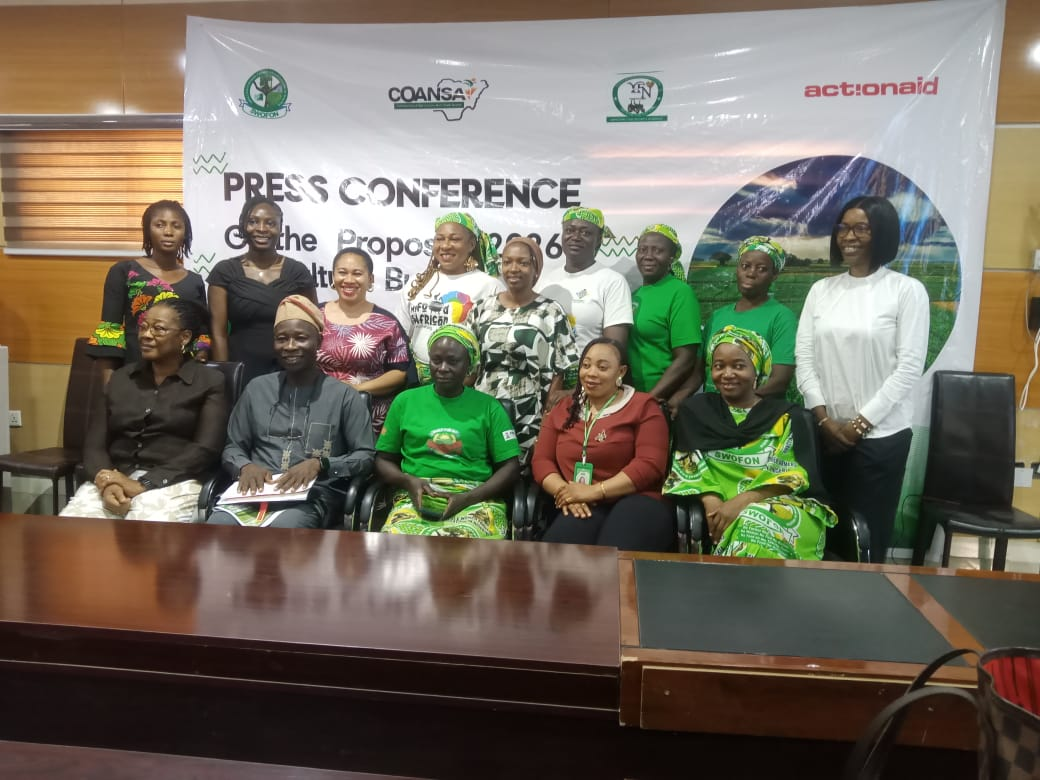
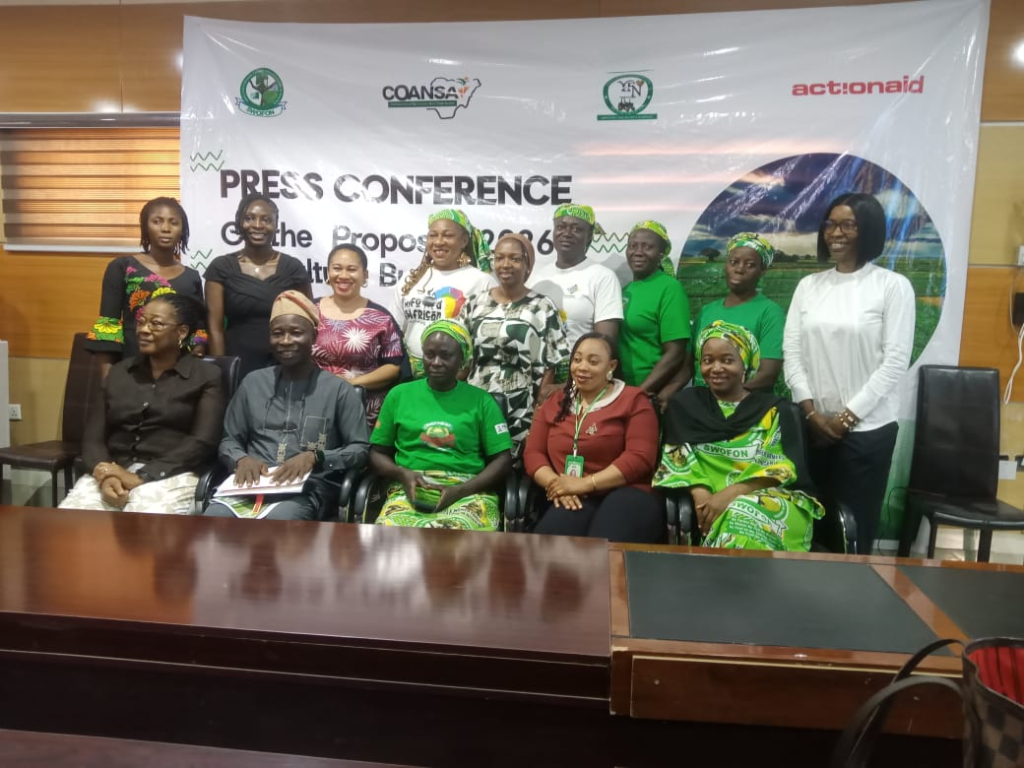
The groups including the Smallscale Women Farmers Organisation in Nigeria (SWOFON), the Community of Agriculture Non-State Actors (COANSA), and Young Farmers in Nigeria (YoFiN) expressed their reservations during a news conference in Abuja while presenting an independent analysis of the Federal Government’s proposed agriculture budget for 2026.
The stakeholders reviewed the funding structure within key policy frameworks such as the National Agrifood Systems Investment Plan (NASIP 2025–2027) and the National Agricultural Technology and Innovation Policy (NATIP 2022–2027). Their assessment also incorporated recommendations from the National Stakeholders Consultative Meeting on the 2026 agriculture budget.
Presenting the joint analysis, Mrs Wakilat Okeji of SWOFON, alongside Gift Adamu of YoFiN and Mr Tosin Zuberu and Dr Gbenga Arokoyo of COANSA, called for stronger funding commitments and improved budget prioritisation for the agricultural sector.
Okeji explained that the 2026 Appropriation Bill allocates N1.45 trillion to the Federal Ministry of Agriculture and Food Security, representing 2.48 per cent of the proposed N58.47 trillion national budget. She added that when the allocation to the Ministry of Livestock Development is included, the agriculture sector’s total share rises marginally to 2.59 per cent.
According to her, the figure marks a decline from the 2025 budget, where agriculture accounted for 4.62 per cent of the federal allocation.
“The reduction is reflected in the overall planned expenditures to ministries, departments and agencies under the NASIP and NATIP programme areas, which dropped by 15.26 per cent from N10.497 trillion in 2025 to N8.896 trillion in the 2026 proposal,” she said.
The stakeholders also recommended that the National Agricultural Development Fund (NADF) be granted first-line charge status and recognised as a statutory allocation to enable it to effectively carry out its mandate.
Dr Arokoyo noted that the fund’s current allocation of N94.14 billion representing 99.46 per cent of its total budget raises concerns about fiscal balance, sectoral equity and the overall impact of the spending.
He further observed that N89.09 billion of the allocation is concentrated in a single initiative, the Renewed Hope Fertiliser Support Programme.
“While fertiliser support remains important, dedicating such a large share of the fund to a single input risks weakening the broader objectives of the Renewed Hope Agenda and fails to address structural challenges faced by smallholder farmers,” he said.
Arokoyo proposed reducing the fertiliser support programme allocation to N10 billion and redirecting the remaining funds to other priority areas capable of delivering broader impact across the agricultural value chain.
These include improving farmers’ access to affordable credit, providing targeted support for women and youth farmers, scaling labour-saving technologies, expanding access to diverse agricultural inputs and addressing post-harvest losses.
Other recommended investment areas include processing and storage infrastructure, farmer training programmes, improved market access and strengthened agricultural extension services.
He also called for greater investment in irrigation systems and Climate Resilient Sustainable Agriculture (CRSA), also known as agroecology, which he described as essential for strengthening resilience against climate shocks and ensuring long-term food security.
Arokoyo emphasised that a more diversified investment strategy would enhance accountability and maximise the developmental impact of the National Agricultural Development Fund.
Also speaking, Zuberu warned that Nigeria may struggle to achieve food and nutrition security if agricultural funding is not properly prioritised and implemented in critical areas.
He identified key priorities to include agricultural extension services, improved access to credit, stronger support for women and youth farmers, irrigation development, labour-saving technologies and climate-resilient farming practices.