
By Agrobroadcast Team
Farmers and agribusiness operators in Kano State have reported significant improvements in productivity and income following their participation in the Kano State Agro-Pastoral Development Project (KSADP), an agricultural intervention designed to strengthen food systems and rural livelihoods.
The testimonies were shared during a ceremony marking the completion of the first phase of the five-year project, which was implemented by the Sasakawa Africa Association (SAA). The initiative focused on improving food security, reducing poverty, creating jobs, and addressing long-standing challenges within agro-pastoral communities.
The project was funded with $95 million provided by the Islamic Development Bank and the Lives and Livelihoods Fund.
Its interventions covered critical areas including crop production, livestock development, irrigation, rural infrastructure, and market access, with SAA leading the crop productivity component.
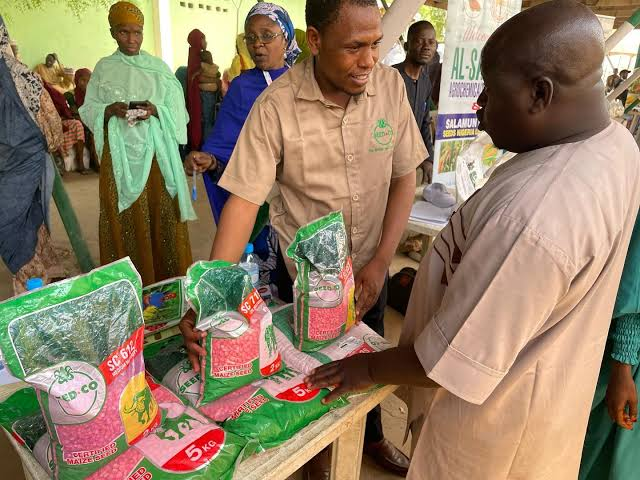
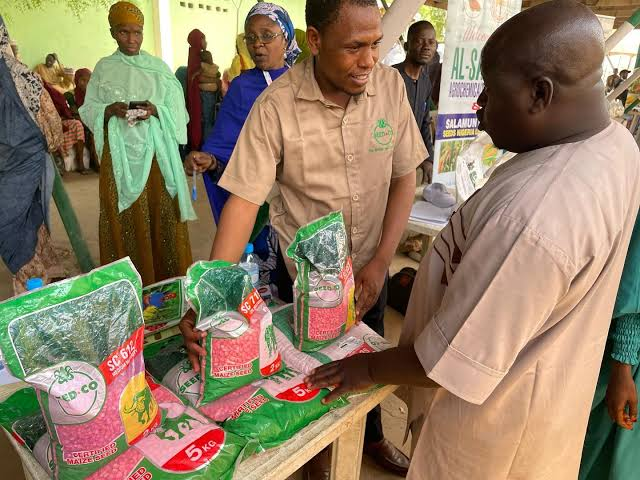
Beneficiaries say the programme changed their farming operations and businesses. Akibu Safiyanu, an agripreneur living with a disability in Dawakin Kudu Local Government Area, said the support he received helped him overcome years of struggle.
He explained that he once lacked the capital to stock basic agrochemicals and operated without a shop, but after enrolling in the programme, he received technical training, a kiosk, and start-up inputs that transformed his livelihood. According to him, proceeds from the business enabled him to complete his Higher National Diploma in Animal Husbandry and become a trusted agricultural service provider in his community.
Laraba Muhammad, a farmer from Kura Local Government Area, also described the intervention as timely, noting that it rescued her from repeated production losses. She said the training on climate-smart agricultural practices not only improved her yields but also positioned her as a trainer for other farmers. Through the project, she was further empowered to produce nutrient-rich food products for children and received a tricycle to support her business operations.
Project Coordinator, Abdulrasheed Hamisu, said KSADP invested heavily in boosting crop yields while prioritising women and youth inclusion across agricultural value chains. He disclosed that the project supported 370 agro-input stockists and distributed 168 milling machines across all 44 local government areas of the state. Other support included 397 rice parboiling kits, nine rice parboiling enterprise centres for women, 75 tomato processing enterprises, 107 groundnut oil extraction units, and 91 onion storage facilities aimed at reducing post-harvest losses.
The Country Director of the Sasakawa Africa Association, Godwin Atser, said the project was introduced in 2020 to address low farm productivity and weak extension delivery systems. He stated that crop yields increased by between 150 and 226 per cent, while post-harvest losses dropped by 51 per cent. According to him, average farmer income rose to about ₦972,462 per hectare, with over 477,000 farmers adopting improved agricultural practices and more than 100,000 women and youth integrated into agribusiness activities.
Several farmers provided examples of the impact. Laraba Muhammad said her half-hectare rice farm produced 38 bags of paddy after receiving training and mentorship, compared to the previous 20 to 25 bags. Another beneficiary, Aminu Bakanike, reported harvesting 62 bags of maize per hectare after receiving improved seeds, fertiliser, and crop protection inputs, a sharp increase from the 27 bags he harvested previously.
With the first phase of KSADP now completed and Sasakawa Africa Association exiting as an implementing partner, concerns were raised about the continuity of the gains recorded. In response, the Permanent Secretary of the Kano State Ministry of Agriculture, Bashir Sanusi, assured stakeholders that the state government has developed a clear strategy to sustain and expand the structures, partnerships, and systems introduced under the project.
The Kano State Agro-Pastoral Development Project was designed to reduce poverty and strengthen food and nutrition security by improving agro-pastoral production systems. Its outcomes so far show that coordinated efforts between government, development partners, and the private sector can significantly improve farmers’ livelihoods and support sustainable food production in Kano State.