
By Agrobroadcast Team
The Kano State Government has initiated plans to collaborate with a French agricultural research institute to enhance rice production and strengthen food security across the state.
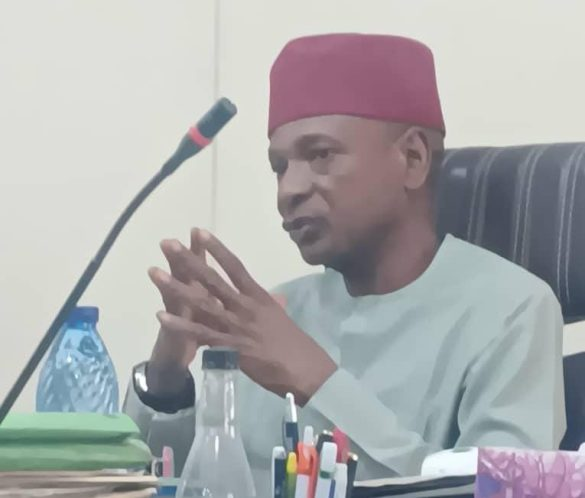
The Commissioner for Agriculture, Danjuma Mamud, disclosed this while speaking with journalists in his office, noting that discussions with the French organisation, CIRAD, began during the Salon International de l’Agriculture exhibition held in Paris.
Mamud explained that the proposed partnership is focused on introducing improved rice varieties and promoting climate-smart agricultural practices capable of significantly increasing yields among farmers in Kano.
According to him, the state government is currently working toward signing a Memorandum of Understanding (MoU) with the research institution after identifying key areas of cooperation.
He said the engagement with CIRAD centred on strategies to improve productivity, particularly by increasing rice yield per hectare.
“Our objective is to introduce climate-smart seed varieties that are resilient and capable of producing much higher yields for our farmers,” Mamud said.
He noted that with the adoption of improved seed varieties and better agronomic practices, farmers who presently harvest between 50 and 60 bags of rice per hectare could potentially triple their output.
“With the right seeds and effective farming techniques, farmers can achieve greater productivity on the same land, and in some cases even with fewer resources,” he added.
The commissioner further revealed that the state government plans to establish demonstration farms where farmers can observe the performance of the improved rice varieties before adopting them on a larger scale.
He said the initiative would help farmers understand the benefits of the new technologies and encourage wider participation, particularly among smallholder farmers.
Mamud also disclosed that Kano State already possesses detailed crop-mapping data which will guide the implementation of the programme.
“We have outlined our needs and shared them with the research institute. With the crop-mapping data already available, the next step is to convert that information into practical interventions that will directly benefit farmers,” he explained.
Beyond improved seeds, the Kano delegation also engaged with several agricultural technology and farm-input companies during the international exhibition to explore mechanisation opportunities.
Among the technologies discussed were handheld, solar-powered threshers designed to help smallholder farmers process harvested crops more efficiently.
Mamud added that during the discussions at the exhibition, Kano reiterated its current stance against the adoption of genetically modified seeds, opting instead for improved but non-GMO varieties.
“Our priority remains climate-resilient seeds and practical innovations that will increase productivity while improving the livelihoods of farmers across the state,” he said.