
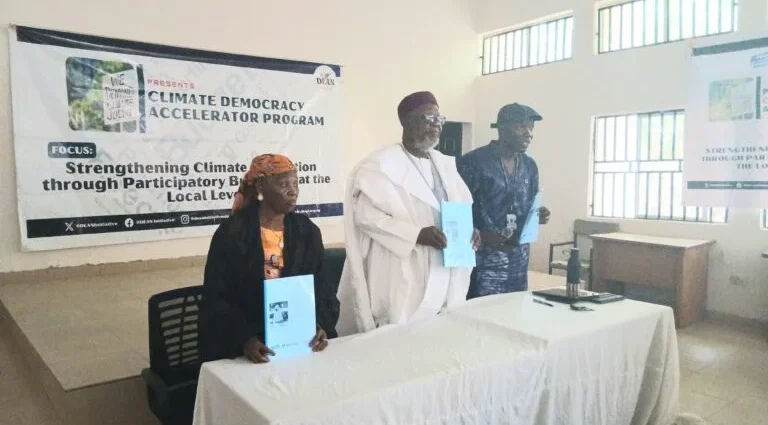
Small-scale farmers in Gwagwalada Area Council have called on the local government to reflect their climate-related needs, farmland security and access to modern farm machinery in the council’s budget.
The call was made during the public presentation of the Climate Participatory Budget Proposal at the council secretariat, where farmers stressed the need for improved seed varieties to help them withstand the growing effects of climate change.
The forum was organised by the Development of Educational Action Network (DEAN) Initiative through its Strengthening Climate Adaptation through Participatory Budgeting project in Gwagwalada, with funding support from People-Powered, an international organisation promoting inclusive democracy.
Gwagwalada has become the first area council in Nigeria to introduce a participatory approach to budget planning, a process facilitated by DEAN.
According to the farmers, unpredictable rainfall patterns, prolonged dry spells, flooding and rising temperatures are increasingly threatening crop productivity and livelihoods.
One of the participants, Ayuba Zubairu, said farmers urgently require climate-resilient seeds for crops such as maize, guinea corn and yam.
“Maize varieties we used to grow took longer to mature, but climate conditions have changed and the growing season is now shorter,” he explained.
“When we plant the same crops today, pests like termites and maggots destroy them. That is why access to improved seeds is critical.”
Zubairu also appealed to the council to allocate additional farmland to local farmers, noting that some existing plots had been taken over for other purposes.
Also speaking, Mrs Rakiya Mamman, a women’s leader from Paiko Community, highlighted the need for urgent government assistance, particularly in the provision of fertilisers and pesticides, to help farmers adapt to climate pressures.
She called for timely support to ensure good harvests, adding that many farmers were yet to receive fertiliser support for the current farming season.
In his remarks, Muhammad Saba, the council’s Open Government Partnership (OGP) Steering Committee Focal Person and Council Secretary, emphasised that citizen involvement in budgeting was essential for effective policy implementation.
Saba noted that as the first council in the country to adopt participatory budgeting, Gwagwalada was committed to maximising the benefits of the OGP framework. He assured participants that the draft proposal would be reviewed by the council’s management team and that farmers’ priorities would be factored into the 2026 budget.
The Executive Director of DEAN, Semiye Michael, said tackling climate challenges facing farmers required collective action, as the effects extended beyond farmers to the entire community that depended on them for food.
He commended the council for leading the initiative and urged it to ensure farmers’ concerns were fully reflected in the 2026 budget.
“I congratulate Gwagwalada for pioneering a democratic budgeting process through direct citizen voting and for empowering residents to address climate change through budget decisions,” he said.
Earlier, Taiye Ojo, Project Lead of DEAN’s Climate Democracy Accelerator Programme, explained that farmers across Gwagwalada communities had undergone capacity-building sessions ahead of the budget process to help them identify their climate priorities and strengthen their skills in climate-smart agriculture.