
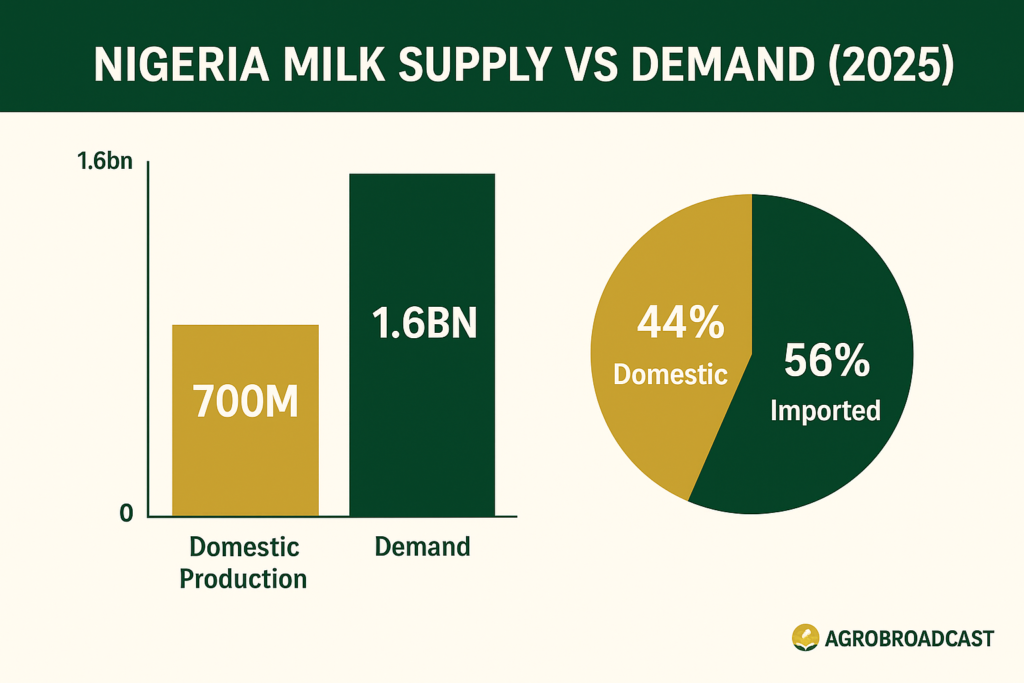
Nigeria’s Federal Government has unveiled a renewed strategy to boost local milk production from the current 700 million litres annually to 1.6 billion litres, matching the country’s fast-rising consumption demand and cutting a yearly US$1.5 billion import bill.
The initiative, driven by the Ministry of Livestock Development and the National Dairy Policy Framework, seeks to reposition Nigeria’s livestock industry as a key pillar of President Bola Tinubu’s Renewed Hope Agenda for food security and economic diversification.
“Nigeria has the cows — we just need coordination”
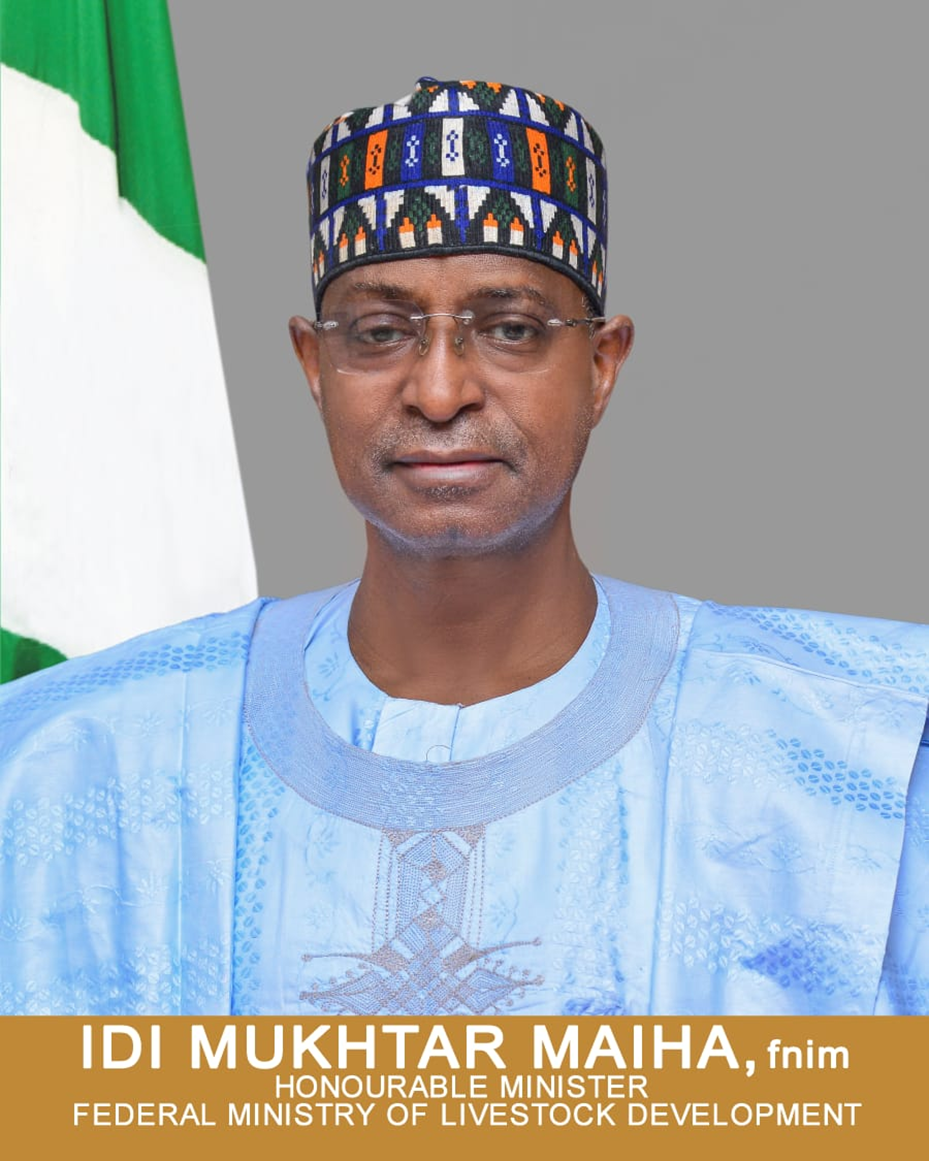
Speaking at the Final Review and Validation Workshop on the Implementation Framework for the National Dairy Policy in Abuja, the Minister of Livestock Development, Idi Maiha, said the country’s existing livestock base—estimated at over 20 million cattle—could meet national milk needs if properly harnessed.
“Our goal is to mobilise investment, create dairy development hubs, and provide soft loans and tariff protection to local producers,” Maiha said. “We can end our dependency on imported milk and powders.”
His counterpart, the Minister of State for Industry, Trade and Investment, Sen. John Enoh, noted that the dairy sector’s production deficit was both “a challenge and an opportunity,” calling the new framework a crucial step toward operationalising Nigeria’s Dairy Policy.
A costly gap between local output and demand
According to data from the National Bureau of Statistics (NBS) and the USDA Foreign Agricultural Service, Nigeria currently produces about 700 million litres of milk annually, less than half of its 1.6 billion-litre consumption demand.
That means every Nigerian consumes an average of just 8–10 litres of milk per year, compared with 35–40 litres in Kenya and 60 litres in South Africa — far below the FAO’s nutrition benchmark of 50 litres per capita.
“Nigeria’s dairy deficit is not about the number of cattle but about productivity,” says Prof. Attahiru Jega, Special Adviser on the National Livestock Reforms Initiative. “The average Nigerian cow yields barely 1 litre per day, compared to 10–15 litres from improved breeds elsewhere.”
🧭 Data Insight 1: National Milk Supply vs. Demand
(Infographic 1 suggestion: Bar chart – Local Production 700mL vs. Demand 1.6bnL)
| Indicator | Volume (Litres) | Share of Demand |
| Domestic Production | 700,000,000 | 44% |
| Import (Powdered/Processed) | 900,000,000 | 56% |
| Total Demand | 1,600,000,000 | 100% |
States leading in milk production
A deep dive into the NBS General Household Survey (2023/24) and the National Agricultural Sample Survey reveals that dairy output is concentrated in Nigeria’s northern belt, where pastoral herding dominates.
Top producing states (estimated share of total milk output, 2024):
- Kano – 13.4%
- Sokoto – 11.7%
- Katsina – 9.8%
- Kebbi – 8.2%
- Bauchi – 7.5%
- Kaduna – 7.1%
Together, these six states contribute over half of Nigeria’s total milk output, mostly through traditional smallholder and nomadic systems. However, less than 3% of the milk produced nationally is processed in formal dairy plants — the rest is sold raw or fermented locally.
🐄 Data Insight 2: Estimated Milk Production by State (2024)
(Infographic 2 suggestion: Map of Nigeria highlighting top 6 milk-producing states)
| Rank | State | Share of National Output | Est. Volume (Litres) |
| 1 | Kano | 13.4% | 93,800,000 |
| 2 | Sokoto | 11.7% | 81,900,000 |
| 3 | Katsina | 9.8% | 68,600,000 |
| 4 | Kebbi | 8.2% | 57,400,000 |
| 5 | Bauchi | 7.5% | 52,500,000 |
| 6 | Kaduna | 7.1% | 49,700,000 |
| Rest of Nigeria | — | 42.3% | 296,100,000 |
| Total | — | 100% | 700,000,000 |
Consumption and nutrition challenges
Despite government campaigns promoting dairy in school feeding and nutrition programmes, milk consumption per child remains among the lowest in sub-Saharan Africa.
Nutrition experts link this to affordability and supply bottlenecks. A litre of fresh milk in urban Nigeria sells for ₦1,200–₦1,600, roughly 2–3 times the price of reconstituted imported milk powder.
“With rising food inflation, milk has become a luxury for many households,” says Dr. Amina Ibrahim, a nutrition policy analyst. “Improving local dairy chains is essential for child nutrition and rural livelihoods alike.”
Government roadmap and next steps
The new National Dairy Policy Framework, validated this week, is built on 11 strategic pillars, including:
- Genetic improvement of local breeds
- Pasture and feed development
- Cold-chain logistics and processing hubs
- Credit support and tariff protection
- Women and youth empowerment in dairy value chains
If implemented fully, experts estimate Nigeria could achieve self-sufficiency by 2032, saving over ₦1 trillion in imports annually and creating 250,000 new jobs in pastoral and processing communities.